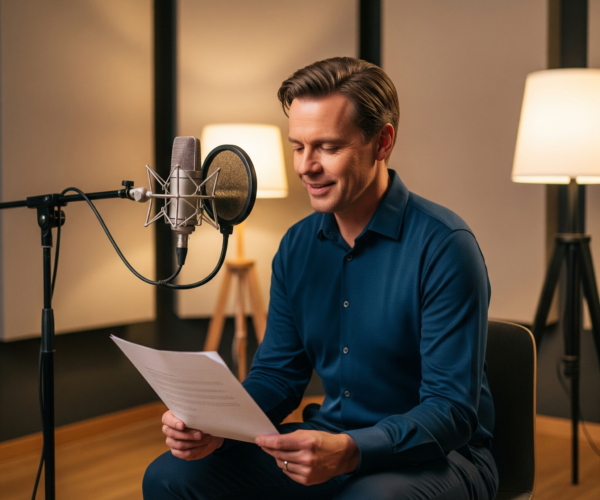
Here are eight tips on how to become a voice actor (or how to become a better voice actor).
1. Practise reading things out loud

Reading things out loud is a simple and practical way to become more comfortable with reading. It can be books, magazines, or news articles—everyday things to get more practice into your daily routine. As a voice actor, it is important to sound natural, but most clients also want different emotions, tones, and styles in their recording. Try changing and testing different styles in your voice as you read. It should never sound like you are reading directly from a piece of paper; it should sound credible, and it is your job to deliver that.
2. Record your voice
Take the next step and record yourself while you read your book or newspaper.
You can also try reciting monologues or reading from a finished script and recording it. Play the recording back to yourself to hear how you sound and make notes for improvements. The sound of your own voice may surprise you! How you sound on a recording is not necessarily the same as how you sound to yourself every day, but it is a good way to evaluate your voice. Also let your family and friends listen to your recordings and provide constructive criticism.

3. Use your diaphragm
When you listen to your voice, consider whether you are using a nasal, mouth, chest, or diaphragm voice. A nasal voice can be a bit unpleasant and whiny, a mouth voice sounds very quiet, a chest voice sounds pleasant, but a diaphragm voice is the most powerful and has the best sound. To develop the diaphragm voice, practise breathing deeply and watch your stomach rise and fall. Make sounds that come from the diaphragm, such as laughing or yawning. Once you get the hang of it, it is simply a matter of maintaining the voice. A voice teacher can help you develop your diaphragm voice.
4. Practise singing/voice exercises
As a voice actor, it is important to be able to control your voice and not wear it out. Your voice is your most important tool, so you want to take care of it.
Certain exercises can help you control and improve your voice. Many of them are based on breathing. You can try humming a scale by blowing through a straw, which will build your breath control. You can lie on the floor and breathe in and out deeply, making a “shh” sound as you exhale. Sitting upright with your shoulders pulled back can make a big difference to your voice. You can also practise articulating difficult words.
5. Improvise different characters
Improvisation is an important skill in voice acting because directors expect it from you. Create a character or use an existing one and come up with scenarios or conversations where you can try different styles. One client may want a recording of someone presenting a fantastic idea with great enthusiasm, another a serious problem being presented, and a third a character for a children’s programme. This skill allows you to truly embody a character and think the way they do. Once you have got into character, try coming up with a funny story on the spot as that character.
6. Imitate the voices of famous actors or fictional characters
Learning to imitate a sound can help you build flexibility and help you recognise tones. You do not need to be an actor to be a voice artist, but it is good to be able to change the sound of your voice. This will allow you to be more versatile and therefore able to get more different types of work. Try not only to imitate the person’s voice, but also their personality, so that you bring them to life instead of just imitating their sound.
7. Take acting classes or find an acting coach
If you want to take things to another level, try acting classes. This will help you develop your acting talent. Since the audience cannot see your facial expressions, hand gestures, or movements, you must express yourself clearly in your voice. You have no props or other tools to help with your delivery. Your emotions and personality must be expressed solely through your voice.
If you do not want to take expensive courses, try finding a community theatre production to take part in.
8. Take voice lessons
Having regular voice lessons can teach you how to better control the volume and sound of your voice. A good voice teacher will not only help you develop strong technique and control, but will also help you find your unique voice. A good voice coach can also help you warm up your voice properly. There are many good singing warm-ups to try. Feel free to Google online for inspiration.
At Voice To Me, we know what it takes for a good voice-over to be professional and sound great.
Read more about voice-over.